



Royal Joker Operational Guide: Mechanics, Sessions and Bankroll Discipline
Provider:
Playson
Type:
Slot
Volatility:
Medium
RTP:
95.62%
Minimum Bet:
0.20
Maximum Bet:
100
Autoplay:
No
Release Date:
25.05.2026
This guide examines how to operate Royal Joker: Hold and Win in practice — from initial bet calibration through bonus-round behaviour to disciplined session management. The content is directed at players who want a working command of the slot's mechanics rather than a marketing overview. All references to specific behaviour are drawn from Playson's certified game documentation.
This guide examines how to operate Royal Joker: Hold and Win in practice — from initial bet calibration through bonus-round behaviour to disciplined session management. The content is directed at players who want a working command of the slot's mechanics rather than a marketing overview. All references to specific behaviour are drawn from Playson's certified game documentation.
The Six-Stage Operational Sequence
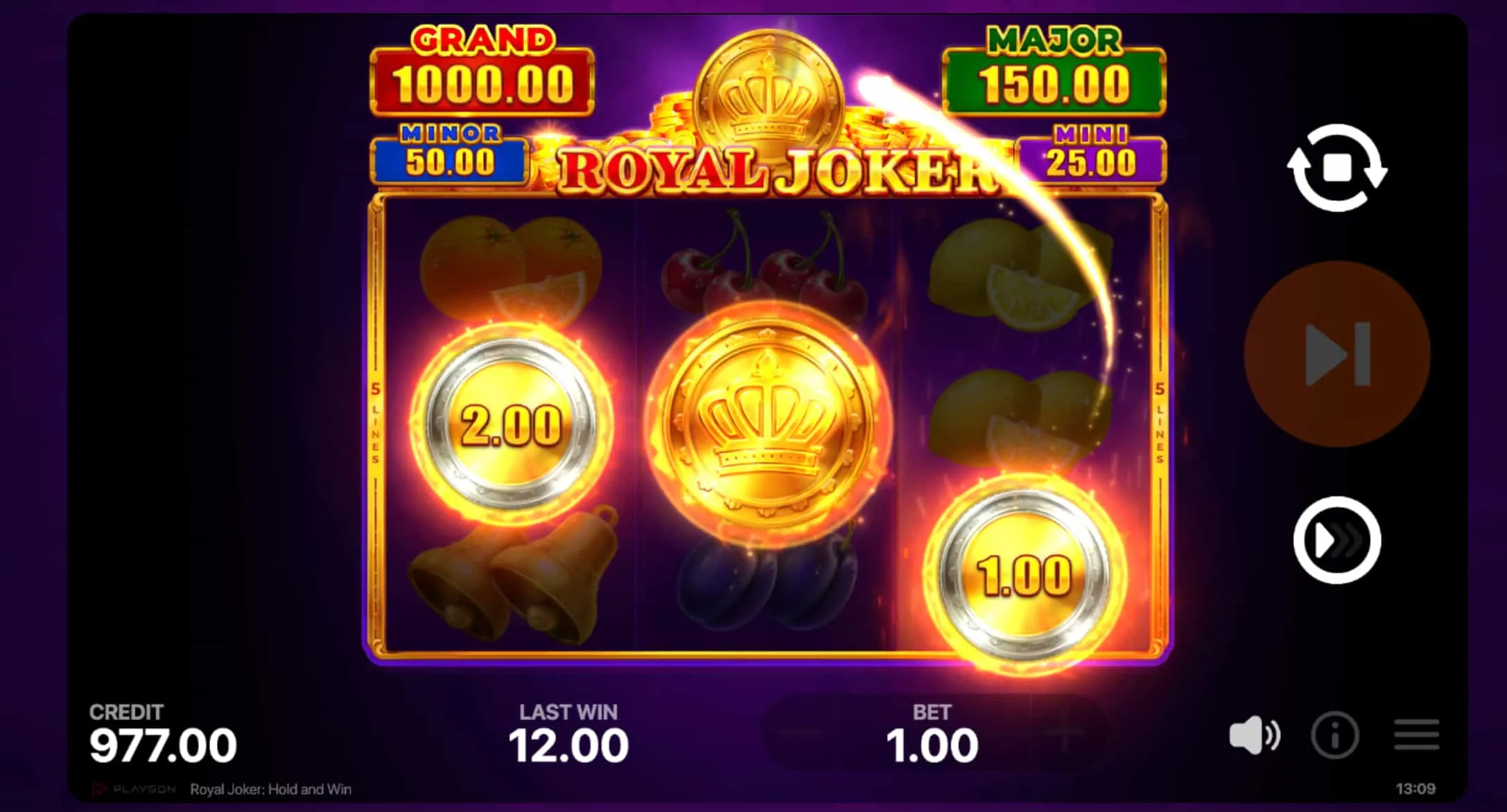
Royal Joker can be played end-to-end with six discrete actions. Each stage corresponds to a specific interface element and a corresponding mechanical state of the game.
Stage 1: Inspect the Paytable Before First Spin
The information panel — accessed via the ‘i' icon in the lower interface — contains the full paytable, payline diagram and rules summary. Experienced players treat this stage as non-optional: knowing in advance that the Wild Joker pays 50× the stake for three matches and that cherries return only 1× materially changes how a player interprets near-misses and partial wins during the session.
Stage 2: Set the Bet Amount Relative to Bankroll
The bet range is £0.20 to £100, controlled by the ‘+' and ‘−' buttons. The selected stake displays in the central bet box and determines all payout calculations including jackpot values. Industry practice for high-volatility slots recommends a single bet of 1% to 2% of the planned session bankroll. The table below illustrates appropriate bet sizes against representative bankrolls.
| £20 | £0.20 – £0.40 | 50-100 spins |
| £50 | £0.50 – £1.00 | 50-100 spins |
| £100 | £1.00 – £2.00 | 50-100 spins |
| £250 | £2.50 – £5.00 | 50-100 spins |
*Based on the assumption of no major wins or losses; actual session length varies with volatility outcomes.
Stage 3: Execute Base-Game Spins
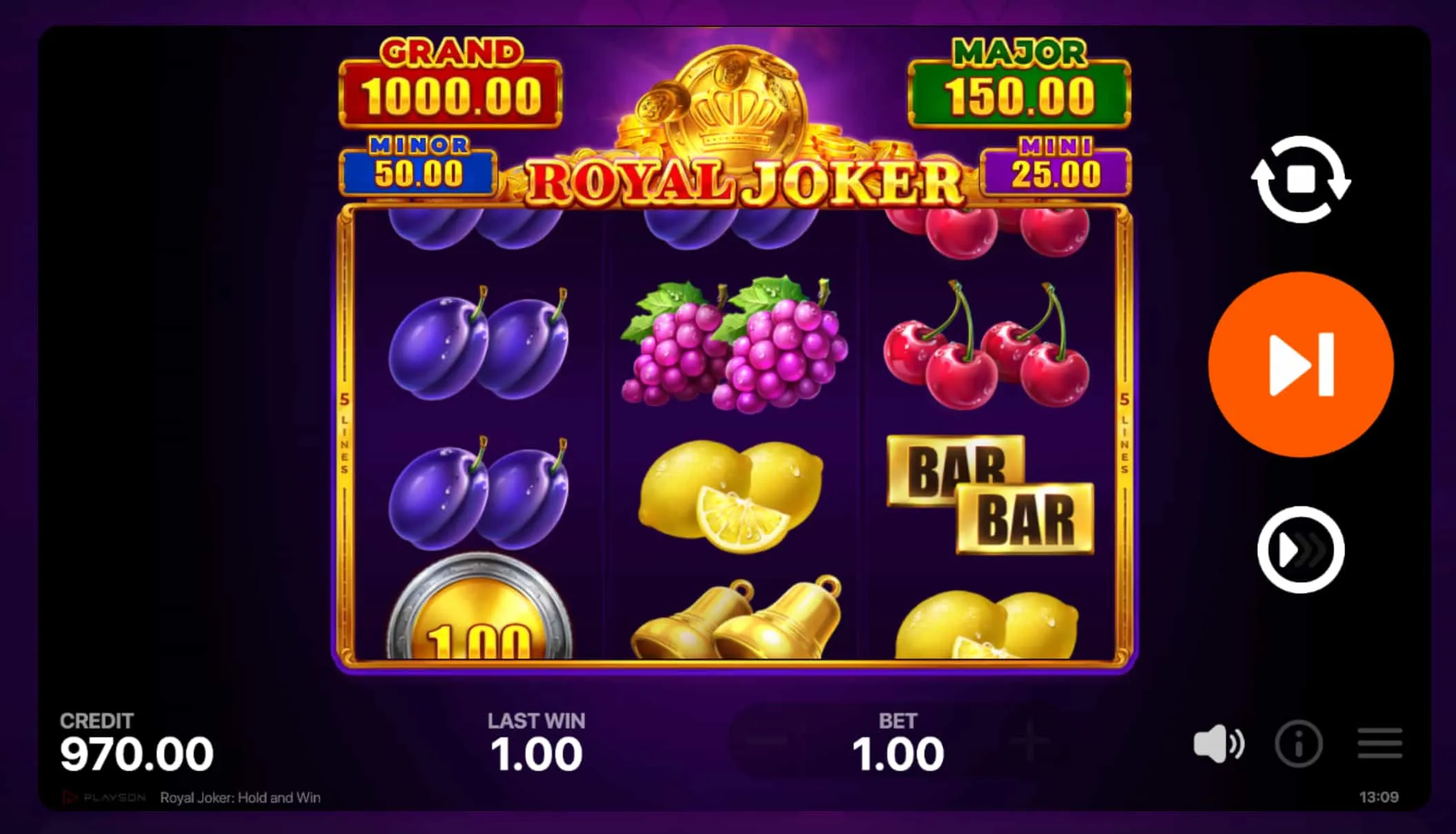
The Spin button initiates a round. Royal Joker operates on five fixed paylines evaluated strictly left to right; any three matching symbols on a payline produce a win. No two-of-a-kind payouts exist. The game automatically highlights winning lines when a payout occurs, reducing the need for manual verification.
Stage 4: Configure Turbo and Autoplay Within Operator Limits
Turbo Spin (lightning icon) accelerates the visual presentation of each spin without altering RNG output. Autoplay (‘A' icon) executes a pre-set number of spins automatically. Every UKGC-licensed operator is required to expose configurable autoplay limits — spin count, loss limit and single-win threshold — which the player must specify before activation. Industry analysis indicates that autoplay sessions correlate with larger average losses than manual play, primarily because they obscure the rate of bankroll attrition; disciplined players use the loss-limit configuration as a hard floor.
Stage 5: Manage the Hold and Win Bonus Round
Three Bonus Coin or Royal Bonus symbols on a single spin trigger the bonus round. The mechanical sequence is as follows:
- The reels reset to display only Bonus, Royal Bonus and Joker symbols; standard fruit symbols are removed from the symbol set
- The respin counter initialises at 3
- Each new qualifying symbol resets the counter to 3
- Royal Bonus symbols remain locked on the middle reel and accumulate the values of every Bonus Coin that lands
- Joker symbols deposit a ×2 multiplier on their cell; a subsequent Joker on the same cell increments the multiplier by one
- The round terminates when three consecutive respins produce no qualifying symbol, at which point the accumulated total is awarded
The 21,150× maximum win figure derives from a specific configuration of full-grid Bonus Coins with maximum multipliers — statistically rare but mathematically possible within a single bonus round.
Stage 6: Monitor for Pile of Gold Activation
Pile of Gold is a random base-game event that injects sufficient Bonus and Royal Bonus symbols to guarantee bonus-round entry. Added symbols occasionally carry a ×2 multiplier. The feature cannot be triggered through bet size, autoplay configuration or any other player input — it is purely RNG-driven and represents an additional, uncontrollable variance source.
Strategic Considerations for High-Volatility Play
No strategy alters the underlying RTP or hit frequency of a slot. What disciplined practice can do is shape the distribution of session outcomes around the long-run mathematical expectation. The following five considerations are derived from established bankroll management principles applied to slots of comparable volatility profile.
- Establish a session bankroll independent of total funds. A pre-committed session bankroll prevents the cognitive bias toward chasing losses that high volatility typically amplifies. Industry data consistently shows that sessions begun without a pre-set ceiling correlate with materially higher loss magnitudes.
- Calibrate bet size to the volatility profile. At a 9.76 volatility index, 1-2% of session bankroll per spin is the consensus recommendation. Higher bet ratios shorten session length disproportionately during the inevitable cold runs that high-volatility mechanics produce.
- Use operator-side limits as the primary safeguard. All UKGC operators expose deposit, loss and session-time limits. These are mechanically enforced and cannot be overridden mid-session, making them more reliable than self-imposed discipline.
- Define a take-profit threshold before play begins. Players who pre-commit to ending a session at a defined win level systematically outperform those who play until losses force a stop, despite the underlying RTP being identical in both cases.
- Treat RTP as a long-run construct, not a session promise. The 95.62% figure is computed over hundreds of thousands of spins. A single session can produce returns ranging from near-zero to multiples of the bankroll. No mechanical adjustment in the short term will correct adverse variance.
Operational Errors Common Among New Players
Analysis of common play patterns identifies four behaviours that consistently produce poor outcomes regardless of player skill or budget. They are addressed below in descending order of impact.
- Increasing bet size during loss streaks. This pattern, known as loss-chasing, amplifies bankroll erosion under high volatility. The 10.14% hit frequency means cold streaks of 15-20 spins are mathematically commonplace; raising stakes within these streaks accelerates depletion without altering recovery probability.
- Operating autoplay without loss-limit configuration. Open-ended autoplay sessions obscure the rate of attrition. Every UKGC operator supports loss-limit configuration; failure to set one is the most preventable cause of session over-extension.
- Skipping the paytable. Players who fail to internalise symbol values misread spin outcomes and underestimate or overestimate the significance of partial wins, leading to suboptimal continuation decisions.
- Playing under cognitive impairment. Research conducted under UKGC oversight establishes that fatigue, stress and intoxication correlate with increased bet size and decreased adherence to pre-set limits. The slot's high-volatility profile amplifies the financial consequences of impaired decision-making.
Targeted FAQ for Operational Concerns
What constitutes an optimal bet size for Royal Joker?
No bet size is mathematically optimal — the RTP applies equally across the £0.20 to £100 range. The practical optimum is the value that allows the planned session length under the player's bankroll: typically 1-2% of session funds per spin for high-volatility slots.
Can the Hold and Win trigger rate be influenced?
No. Bonus triggers are determined solely by the RNG and are independent of bet size, autoplay configuration, time of day or any prior outcomes. Any pattern that appears to influence trigger frequency reflects observation bias rather than mechanical reality.
Should autoplay be used during Royal Joker sessions?
Autoplay is mechanically neutral — it produces the same RNG outcomes as manual spinning. The associated risk is behavioural: it can mask the rate of bankroll loss. When used, autoplay should always be configured with a spin-count cap and an explicit loss limit at the operator level.